AI is becoming more powerful every day. But are businesses becoming equally confident in the systems they trust to make decisions?
Imagine a company that has invested millions of dollars in artificial intelligence.
Its recruitment system screens thousands of applications in minutes. Its financial platform evaluates creditworthiness. Its customer service agent responds around the clock. Its predictive models help leadership make decisions faster than ever before.
The technology appears impressive. The business is becoming more efficient. The results look promising.
But beneath the surface, important questions remain unanswered.
What if the recruitment system consistently disadvantages qualified candidates from certain backgrounds? What if the financial model relies on inaccurate or outdated data? What if an AI agent accesses information it should never have been able to reach? What if a business cannot explain why its system made a consequential decision?
And perhaps the most important question of all:
If someone asked your organization to prove that its AI system was operating responsibly, would you have the evidence to support your answer?
This is the AI trust gap.
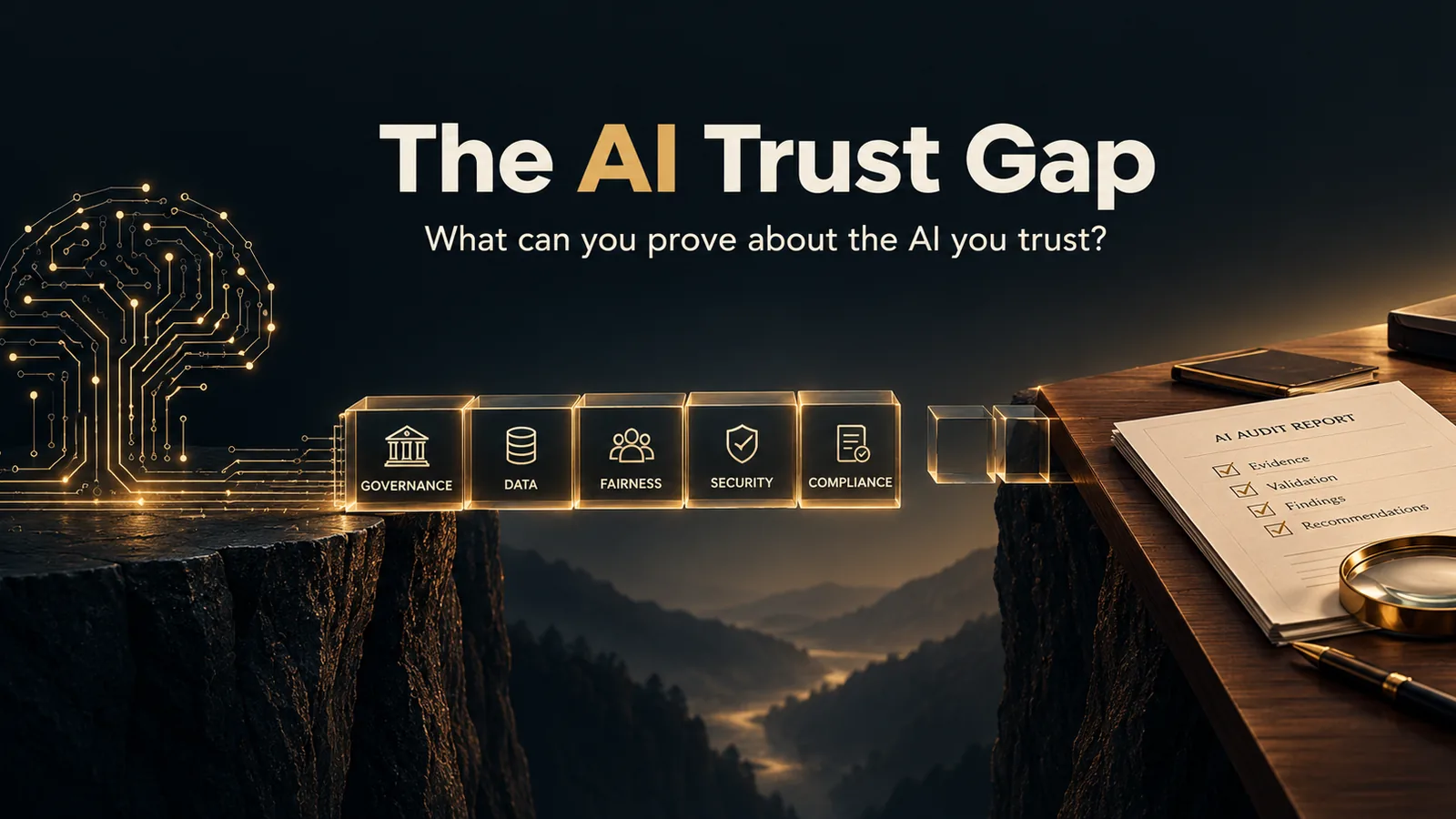
It is the distance between what an organization believes its AI systems can do and what it can actually demonstrate about their reliability, fairness, security, governance, and compliance.
As businesses move from experimenting with AI to embedding it in critical operations, closing this gap is becoming an important part of responsible business leadership.
At iDharma, we believe that AI innovation must be accompanied by independent scrutiny, evidence-based assessment, and a clear understanding of risk.
Because the future of AI will not be determined by capability alone. It will also be shaped by accountability.
1. The AI revolution has created a new business responsibility
Artificial intelligence is no longer confined to research laboratories or experimental technology projects. Organizations across industries are incorporating AI into everyday business decisions.
- Financial services: AI can support fraud detection, credit assessment, and risk analysis.
- Healthcare: it can assist with administrative workflows, medical information processing, and clinical decision support.
- Human resources: automated systems can help screen applications, rank candidates, and support workforce planning.
- Retail and customer service: AI can personalize recommendations, automate interactions, and analyze customer behavior.
- Enterprise operations: AI agents can retrieve information, interact with software, summarize documents, and perform tasks with varying levels of autonomy.
These capabilities offer real advantages: faster processes, better access to information, greater operational efficiency, and the potential to make complex work more manageable.
However, the consequences of an AI failure depend on where and how the technology is used.
An inaccurate product recommendation and an inaccurate credit decision do not carry the same level of risk. An AI-generated internal summary and an autonomous system authorized to take business actions require different levels of oversight.
This is why organizations cannot evaluate every AI system using a single measure of success. Speed is important. Accuracy is important. Cost savings are important. But none of these, on its own, establishes that an AI system is trustworthy.
The more influence AI has over business decisions, the more important it becomes to understand the risks behind those decisions.
2. The problem with trusting AI based on performance alone
One of the most common mistakes organizations can make is assuming that a system performing well in testing will necessarily perform well in every real-world situation.
Consider a hypothetical organization using AI to screen job applications. During initial testing, the system appears efficient. It processes applications quickly, applies consistent criteria, and reduces the workload for the recruitment team. From an operational perspective, the implementation appears successful.
But a closer assessment might reveal that the system uses historical hiring patterns that do not adequately represent the diversity of the qualified candidate pool. Certain groups could receive lower selection rates, or particular qualifications might be evaluated inconsistently.
The system may be efficient without being sufficiently fair.
Now consider a financial services company using an AI model to identify potentially fraudulent transactions. The model performs well on historical data. However, customer behavior changes, new fraud patterns emerge, and the underlying data gradually becomes less representative of current conditions. Without appropriate monitoring and review, yesterday's performance may create a false sense of security about tomorrow's results.
Or imagine an organization deploying an AI agent that can access internal documents and interact with business applications. The agent may complete its assigned tasks correctly most of the time. Yet weak access controls, insufficient testing, or unclear human approval requirements could create risks that are not visible during an ordinary demonstration.
These examples are illustrative scenarios, not claims about specific companies or incidents. They demonstrate a broader principle.
An AI system can deliver useful results and still contain risks that deserve independent examination.
Performance testing answers important questions about how a system behaves under specified conditions. AI auditing can examine additional questions about governance, data, fairness, security, documentation, and relevant requirements. The two serve different but complementary purposes - which is also why a single accuracy figure tells you so little on its own.
3. What is an independent AI audit, and why does it matter?
An independent AI audit is a structured assessment of an AI system against an agreed methodology, defined assessment scope, and relevant standards or regulatory requirements. Its purpose is to examine what can be demonstrated, identify gaps, and provide a clearer understanding of the system's risks.
Unlike a general discussion about AI ethics, an audit should connect its conclusions to evidence.
- Instead of merely asking whether a company values fairness, the assessment can examine what fairness controls exist, whether appropriate testing has been performed, and what the available evidence demonstrates.
- Instead of asking whether a company takes security seriously, the assessment can examine relevant access controls, documentation, safeguards, and testing evidence within the agreed scope.
- Instead of accepting a broad claim of regulatory readiness, the assessment can identify which requirements are relevant, what evidence supports them, and where further work may be necessary.
The distinction is important. A policy may describe what an organization intends to do. An assessment examines the evidence available to determine whether the relevant controls and practices are actually in place.
An audit does not automatically mean that a system is risk-free, nor does every audit establish legal compliance or constitute formal certification. Its conclusions depend on the scope, methodology, evidence, and requirements examined.
The objective is not to create a false sense of certainty. It is to replace assumptions with better-informed decisions. (For the longer answer, see What Is an AI Audit?)
4. Five critical dimensions of responsible AI assessment
At iDharma, our published audit approach examines five key dimensions: governance, data, fairness, security, and compliance. These dimensions help organizations examine different aspects of AI risk rather than focusing exclusively on model performance.
A. AI governance: Who is accountable when AI makes a decision?
Technology does not eliminate organizational responsibility. When an AI system produces a harmful, inaccurate, or unexpected outcome, an organization needs to understand who is responsible for reviewing the issue, escalating it, and deciding what happens next.
Effective AI governance considers questions such as:
- Who owns each AI system?
- Who approves its deployment and significant changes?
- Who is responsible for monitoring its performance and risks?
- What happens when the system produces an unexpected result?
- When must a human review or override an AI-generated decision?
- How are risks documented, escalated, and communicated to leadership?
Without clear accountability, even well-designed technical controls can become ineffective. A team may identify a problem without knowing who has the authority to address it. A policy may exist without a defined owner. A system may be updated without an appropriate review of the resulting risks.
Governance helps connect technical controls with management responsibility. It also enables leadership to understand where AI is being used, which systems are most consequential, and what oversight is appropriate for each use case.
B. Data: What information is influencing the system?
AI systems are shaped by the data they receive, the information used during their development, and the context in which they operate. Poor-quality, incomplete, outdated, or unsuitable data can affect system behavior and the decisions that follow.
Organizations should understand the origin and intended use of relevant data, the limitations of available datasets, and the safeguards governing access and processing. Depending on the system, an assessment may examine:
- Data provenance and documentation.
- Data quality and representativeness.
- Access permissions and information flows.
- Privacy-related controls and applicable obligations.
- Data retention and handling practices.
- The suitability of data for the system's intended purpose.
Data governance is particularly important when AI systems process personal, confidential, financial, or otherwise sensitive information.
For example, an organization may have a legitimate business purpose for using AI to analyze customer interactions. That does not automatically mean every piece of information in those interactions is appropriate for every processing purpose. The relevant questions include what data is used, why it is used, who can access it, and what rules apply.
Reliable AI requires more than sophisticated algorithms. It requires appropriate data practices and an understanding of their limitations.
C. Fairness: Does the system create outcomes that deserve closer examination?
AI systems can reproduce or amplify patterns found in historical data, design decisions, or the environments in which they are deployed.
This does not mean every AI system is biased or that every difference in outcomes demonstrates unlawful discrimination. It means organizations should investigate potential unfairness where it is relevant to the system's purpose and impact.
An assessment may examine whether appropriate fairness tests have been performed, which populations or groups were considered, whether the testing methodology is suitable, and what the results demonstrate. Depending on the use case, this could include examining selection rates, error rates, impact measures, or differences in system performance across relevant groups.
Consider an automated employment decision tool. A company may observe that its hiring process is faster after introducing the tool. Yet efficiency alone cannot establish whether the tool produces concerning differences in outcomes across demographic groups.
In some jurisdictions, specific requirements apply to certain automated employment decision tools. New York City's Local Law 144, for example, addresses bias audits, publication of specified information, and candidate or employee notices for covered uses. The precise obligations depend on the law's scope and the circumstances of deployment.
A meaningful assessment therefore begins with the actual system, its use case, the relevant population, and the applicable requirements - not with a generic assumption that one test fits every situation.
D. Security: What happens when someone challenges or misuses the system?
AI introduces security considerations that may extend beyond those associated with conventional software. Depending on the technology, risks can involve unauthorized access, sensitive information exposure, manipulated inputs, unsafe integrations, or unintended actions by AI agents.
An AI system connected to internal databases and business applications may create a different risk profile from an isolated tool used to summarize non-sensitive documents. Security assessment should reflect those differences. Questions may include:
- Are access permissions appropriate to each user's role?
- Is sensitive information adequately protected?
- Have relevant attack scenarios been considered?
- Are system integrations and external dependencies understood?
- Can inappropriate actions be detected and investigated?
- Are there suitable controls for human approval and escalation?
For AI agents, organizations may also need to examine the permissions granted to the agent, the actions it can perform, and the boundaries placed around those actions. A system that can recommend a payment is not equivalent to one that can independently initiate it. The level of autonomy, the potential impact of errors, and the available safeguards all matter.
Security is therefore not simply a technical feature to be checked once. It is part of understanding how an AI system behaves within its broader operating environment.
E. Compliance: Which requirements actually apply?
The regulatory environment surrounding AI is complex and evolving. Different requirements may apply depending on the organization's location, industry, role, use case, the people affected, and the data involved.
Relevant instruments may include the EU AI Act, the NIST AI Risk Management Framework, ISO/IEC 42001, applicable privacy laws, sector-specific obligations, and other jurisdictional requirements. These instruments are not interchangeable. Some are laws or regulations. Others are voluntary frameworks, technical standards, or guidance. Their scope, legal effect, and applicability differ. For example:
- The EU AI Act establishes a risk-based legal framework for AI and contains obligations that depend on the system, the organization's role, and other applicability conditions.
- The NIST AI Risk Management Framework provides a voluntary structure for managing AI risks through its Govern, Map, Measure, and Manage functions.
- ISO/IEC 42001 specifies requirements for an AI management system.
- Privacy laws may impose obligations relating to personal data, transparency, rights, or certain automated decisions.
- New York City's Local Law 144 addresses specified automated employment decision tools used in covered employment contexts.
An organization should not assume that every instrument applies to every AI system. Nor should it assume that addressing one framework automatically satisfies every other applicable obligation.
The first step is to understand the use case and determine which requirements are relevant. The next is to examine the evidence against those requirements, document identified gaps, and prioritize appropriate action.
Compliance is not a label to apply to AI. It is a set of applicable obligations that must be understood, assessed, and addressed with evidence.
5. AI governance is not just a legal or technical issue
It is tempting to treat AI risk as the responsibility of a single department. The technology team manages the model. The legal team interprets regulations. The compliance team maintains policies. Senior management reviews performance.
But AI systems frequently operate across these boundaries. A model can be technically functional while creating a business risk. A legally relevant obligation can require technical evidence. A security weakness can affect customer trust. A governance gap can prevent a company from responding appropriately when an incident occurs.
Responsible AI therefore requires coordination across technical, legal, risk, compliance, and business functions.
Leadership has a particularly important role. Executives need visibility into the AI systems being deployed, the decisions those systems influence, the risks that matter most, and the resources needed to address them.
Boards and senior management should not need to understand every technical detail of a model to ask meaningful questions about its use. They should, however, be able to ask:
- What is this system being used for?
- What could happen if it fails?
- Who is accountable for its use?
- What evidence supports our confidence in it?
- What happens when the system changes or the risk profile increases?
These are business questions as much as technology questions.
6. From reactive compliance to proactive AI assurance
Organizations often begin investigating AI governance when a customer raises a concern, a procurement team requests documentation, an internal review identifies a gap, or a regulatory deadline approaches.
Responding to an immediate requirement is understandable. However, a reactive approach can leave businesses with an incomplete understanding of their AI systems. A more structured approach begins before problems become urgent.
- Understand the AI footprint. Identify the AI systems the organization develops, purchases, deploys, or embeds in third-party software. Include relevant tools and integrations that may not be immediately obvious.
- Establish the context and risk. Determine what each system does, whose interests it may affect, what decisions it supports, and how much autonomy it has.
- Identify applicable requirements. Map the system's use case to relevant laws, standards, frameworks, and internal policies. Involve qualified legal counsel where legal interpretation is required.
- Examine the evidence. Review appropriate documentation, controls, testing, monitoring, and operational practices against the agreed audit scope.
- Prioritize the findings. Not every gap has the same significance. Consider the potential consequences, applicable obligations, likelihood of harm, and urgency when determining priorities.
- Assign responsibility and follow through. Translate findings into practical actions with accountable owners, appropriate timelines, and evidence of completion.
- Reassess when circumstances change. AI systems evolve. Models, data, integrations, business purposes, and regulatory expectations can change. Organizations should consider reassessment when significant changes or new risks warrant it.
This approach helps move AI governance away from a one-time documentation exercise and toward a more continuous management discipline.
An independent audit can provide a structured view of the current position. The organization remains responsible for deciding how to respond to findings and implementing appropriate improvements.
7. Why independence matters in AI auditing
One of the most important questions in any assessment is not simply who conducted it, but whether the assessment can be trusted.
If an organization evaluates its own system, internal teams may possess valuable knowledge and technical expertise. Internal reviews are an important part of responsible governance.
However, an independent assessment can provide a different perspective by examining the system against an agreed methodology without being responsible for building or selling the technology being assessed. This separation can help reduce conflicts of interest and encourage evidence-led conclusions.
At iDharma, independence is central to our stated approach. We assess AI systems that we do not build or sell, and we do not sell the fixes we recommend. Our published methodology emphasizes defined scope, named standards, traceable evidence, and findings that can be examined. (More on this in what "independent" actually means in an AI audit.)
The principle is straightforward: an assessment should not be designed to produce a predetermined conclusion. It should be designed to determine what the evidence supports.
That also means being clear about limitations. An audit covers an agreed scope and cannot establish that every possible risk has been eliminated. Findings must be understood in the context of the system, the methodology, the evidence reviewed, and the requirements being assessed.
Independence does not replace technical competence, appropriate testing, or sound methodology. It complements them. The value of an audit ultimately depends on the quality of the assessment and the usefulness of its conclusions.
8. What should an organization expect from an AI audit?
A meaningful AI audit should deliver more than a vague statement that a system is safe or unsafe. Organizations need to understand what was examined, what evidence was reviewed, what was found, and what should happen next.
Depending on the agreed scope and type of assessment, useful outputs can include:
- A clearly defined scope: Which systems, processes, requirements, and assessment activities were included?
- A documented methodology: What criteria were used, and how were conclusions reached?
- Evidence-linked findings: What specific evidence supports each finding, and where are the limitations?
- Risk prioritization: Which gaps deserve attention first, based on their significance and the applicable requirements? (See how we grade findings.)
- An actionable improvement plan: What steps should the organization consider, who should own them, and how can progress be evaluated?
- An executive-level summary: What does leadership need to understand about the system's risk profile and the decisions required?
These outputs help translate technical and regulatory complexity into practical business decisions.
At iDharma, our published audit offering describes a structured process that includes scoping, assessment, a prioritized findings report, and a report walkthrough. The precise deliverables depend on the engagement and agreed scope.
An audit report should not be treated as the end of the governance process. Its value lies in helping an organization understand its current position and make informed decisions about what comes next.
9. The business case for AI trust
Responsible AI is sometimes discussed as though it were simply an additional cost or a barrier to innovation. That perspective overlooks the business value of understanding risk.
A structured assessment can help organizations identify weaknesses before they become more expensive to address. It can support internal decision-making, strengthen risk management, and help teams prepare appropriate documentation for relevant stakeholders. It may also help organizations respond more effectively to questions from enterprise customers, procurement teams, investors, partners, and regulators.
Consider a business seeking to introduce an AI-powered service to a large enterprise customer. The customer may want to understand how the system handles data, how its risks are managed, what security measures exist, and what evidence supports the supplier's claims.
A company that has documented its systems, assessed relevant requirements, and established clear accountability may be better positioned to answer those questions than a company relying entirely on general assurances.
This does not mean that an audit automatically guarantees a sale, prevents an incident, or establishes compliance with every applicable law. It means that a more structured understanding of AI risk can support better business decisions.
Trust is not created by saying the right things about AI. It is strengthened when an organization can explain its practices and substantiate its claims.
In a market where AI capabilities are becoming more accessible, the ability to demonstrate responsible use may become an increasingly important differentiator.
10. The questions every business leader should ask today
Before deploying a new AI system, expanding its use, or allowing it to influence important decisions, leadership should consider the following questions.
- Visibility: Do we know which AI systems are operating across our organization, including those embedded in third-party tools?
- Purpose: Is every system being used for a clearly defined and appropriate purpose?
- Accountability: Is there a named owner responsible for the system's use, oversight, and escalation?
- Evidence: What supports our confidence in the system's performance, fairness, security, and reliability?
- Data: Do we understand the information being processed and the controls governing its use?
- Human oversight: Can people intervene when the system produces an unexpected or consequential outcome?
- Regulatory relevance: Have we identified the requirements that actually apply to our system and use case?
- Independent scrutiny: Has the system been assessed with sufficient independence and against an appropriate methodology?
- Remediation: If a gap is identified, do we know who will address it and how the improvement will be verified?
- Ongoing review: What changes would trigger another assessment?
Organizations do not need to have every answer immediately. But they should know which questions remain unanswered and have a plan for addressing them. That is a practical starting point for responsible AI governance.
11. The future belongs to organizations that can demonstrate trust
Artificial intelligence will continue to evolve. Models will become more capable. AI agents will perform more complex tasks. Businesses will discover new ways to automate workflows, support decisions, and develop products and services.
With these opportunities will come new questions about accountability, fairness, security, privacy, and oversight.
The answer is not to reject innovation or assume that every AI system is inherently dangerous. Nor is it to trust every system simply because it appears sophisticated or produces impressive results.
The answer is to approach AI with the same seriousness that organizations bring to other consequential business decisions. Understand the purpose. Examine the evidence. Identify the risks. Establish accountability. Apply the relevant requirements. Address the gaps. And be honest about what is known, what remains uncertain, and what needs to improve.
This is where independent AI auditing has an important role to play.
At iDharma, we believe that businesses should be able to move forward with AI while developing a clearer understanding of the systems they rely on. Our focus is on independent assessment, evidence-based findings, and practical clarity about risks and next steps.
Because responsible AI is not about promising perfection. It is about creating the conditions for informed decisions, meaningful accountability, and continuous improvement.
The next stage of AI adoption will require more than organizations that know how to use the technology. It will require organizations that understand how to evaluate it, govern it, and demonstrate why it deserves to be trusted.
The question is no longer just, "What can your AI do?"
The question is, "What can you prove about the AI you trust?"
At iDharma, we believe that is where responsible AI begins.
Start with a clearer understanding of your AI risks
If your organization uses AI in hiring, financial services, healthcare, customer operations, or other business-critical processes, consider whether an independent assessment could help you understand your current risk and governance position. Explore iDharma's AI audit approach, or request an audit to talk to our team about scope.
Note: This article is for general educational purposes. The applicability of laws, regulations, and standards depends on the circumstances of each organization and AI system. An AI audit does not, by itself, guarantee compliance, eliminate all risk, or constitute legal advice or formal certification.
About the author
Brijesh Kumar Patel, Founder of iDharma, is focused on advancing independent AI auditing and responsible AI governance, helping organizations build greater trust through evidence-based AI assessments.
Frequently asked questions
- What is the AI trust gap?
- It is the distance between what an organization believes its AI systems can do and what it can actually demonstrate about their reliability, fairness, security, governance and compliance.
- Is good performance in testing enough to trust an AI system?
- No. Performance testing shows how a system behaves under specified conditions. An audit examines further questions about governance, data, fairness, security, documentation and the requirements that apply. The two are complementary.
- What does an independent AI audit examine?
- iDharma's published approach examines five dimensions: governance, data, fairness, security and compliance, each measured against an agreed scope, methodology and the standards or regulations that apply.
- Does an AI audit guarantee compliance?
- No. An audit covers an agreed scope and its conclusions depend on the methodology, evidence and requirements examined. It does not by itself guarantee compliance, eliminate all risk, or constitute legal advice or formal certification.
- Why does independence matter in an AI audit?
- An assessor that does not build, sell or fix the system being assessed has no stake in the answer. That separation reduces conflicts of interest and keeps the conclusions tied to what the evidence supports.